Kinetiq | Liquid Staking on Hyperliquid
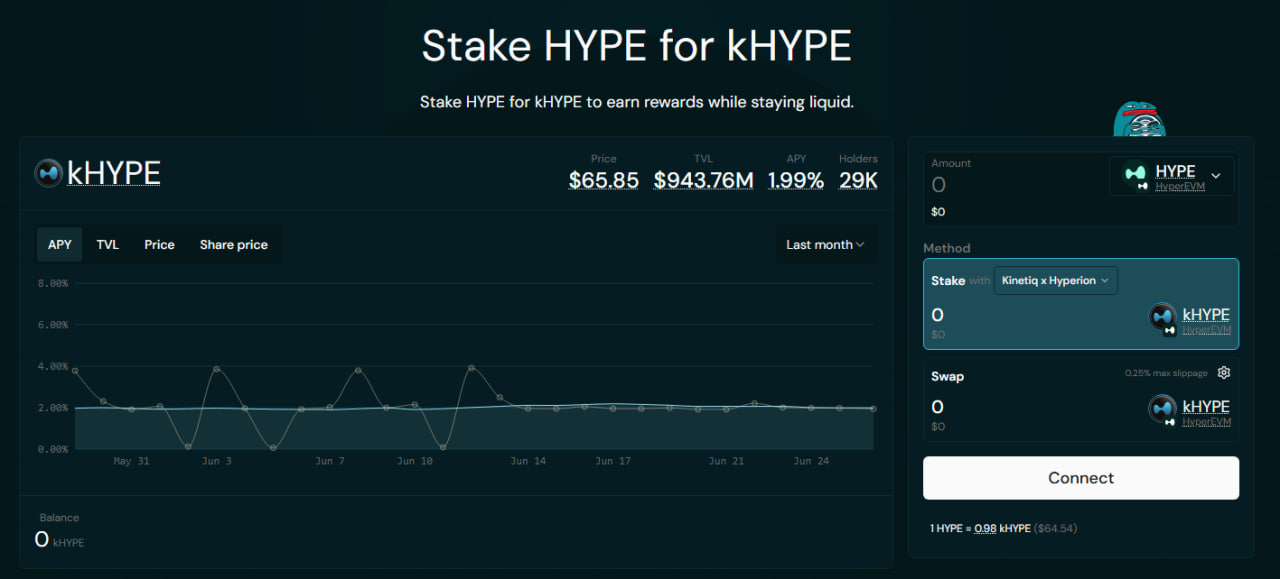
Kinetiq is a Hyperliquid-native liquid staking and DeFi infrastructure project. Its core product lets users stake HYPE, the native asset of the Hyperliquid blockchain, and receive Kinetiq Staked HYPE, or kHYPE, in return. The main value proposition is simple: users can participate in staking while keeping a liquid token that can be used across the Hyperliquid DeFi ecosystem.
This Kinetiq crypto guide explains how the Kinetiq project works, what kHYPE and KNTQ are, how the protocol connects to HyperEVM, Launch, Markets, and Earn, and what risks readers should understand before interacting with any smart contract. It is written for both beginners exploring liquid staking and crypto-native users comparing Hyperliquid DeFi infrastructure.
This article covers
- What Kinetiq is and why liquid staking matters on Hyperliquid.
- How HYPE staking, kHYPE, validator delegation, and withdrawals work.
- Kinetiq ecosystem products, including Earn, Markets, Launch, and institutional staking.
- What is officially known about the KNTQ token and sKNTQ incentives.
- Public metrics, audits, bug bounty information, and key user risks.
What Is Kinetiq?
Kinetiq is a liquid staking protocol built natively for Hyperliquid. According to the official Kinetiq documentation, users can stake HYPE and receive kHYPE, which is designed to keep staking participation liquid and usable in DeFi. Instead of forcing users to choose between staking and liquidity, Kinetiq packages staked HYPE into a liquid staking token that can be held, transferred, integrated, or deployed in supported HyperEVM applications.
The protocol’s category is best described as DeFi liquid staking infrastructure, with adjacent products in yield aggregation, exchange infrastructure, and perpetual markets. Kinetiq is not just a simple staking interface. Its documentation describes an autonomous validator scoring and delegation system called StakeHub, products such as Kinetiq Earn, Markets by Kinetiq, Launch, and institution-focused iHYPE staking rails.
The company or organization name publicly shown across the official website and GitHub is Kinetiq Research. The GitHub organization is verified and describes itself as “Liquid Staking and Markets on Hyperliquid.” Public team-member details are limited, so this page avoids making claims about founders or individual operators.
| Item | Details |
|---|---|
| Project | Kinetiq |
| Category | Liquid staking, DeFi infrastructure, Hyperliquid ecosystem |
| Primary ecosystem | Hyperliquid and HyperEVM |
| Main staking asset | HYPE |
| Liquid staking token | kHYPE, officially called Kinetiq Staked HYPE |
| Governance token | KNTQ, officially confirmed in Kinetiq documentation |
How Kinetiq Works
The basic user flow starts with HYPE. A user connects a compatible wallet, stakes HYPE through Kinetiq, and receives kHYPE. Kinetiq then delegates the underlying HYPE to Hyperliquid validators. The user keeps kHYPE in their wallet, while the value of kHYPE relative to HYPE is designed to increase as staking rewards accrue.
Kinetiq’s documentation states that kHYPE rewards do not require manual claiming or rebasing. Instead, rewards are reflected through an improving exchange rate. This model is common among liquid staking tokens because it lets the token balance stay constant while the redemption value changes over time.
Behind the scenes, Kinetiq’s StakeHub system evaluates validators and distributes stake according to performance and risk criteria. Kinetiq describes this as autonomous validator management: validators are scored, monitored, and rebalanced without each user manually choosing a validator. The goal is operational simplicity, better diversification, and reduced exposure to underperforming validators.
Withdrawals are not instant in the standard unstaking path. The kHYPE documentation describes a queue-based process where a user requests to unstake, waits through the relevant delay period, and then confirms the withdrawal to receive HYPE. Kinetiq’s docs describe the total unstaking timing as roughly eight to nine days, including a delegation lockup and unstaking queue. Users who want faster liquidity may be able to trade kHYPE on supported markets, but that introduces price, slippage, and liquidity risks.
Kinetiq Ecosystem and Core Features
The Kinetiq ecosystem has expanded beyond the original kHYPE staking product. The official site positions Kinetiq as “powering liquid staking and Markets on Hyperliquid,” and its documentation organizes the product suite around liquid staking, protocol products, and Launch.
kHYPE liquid staking
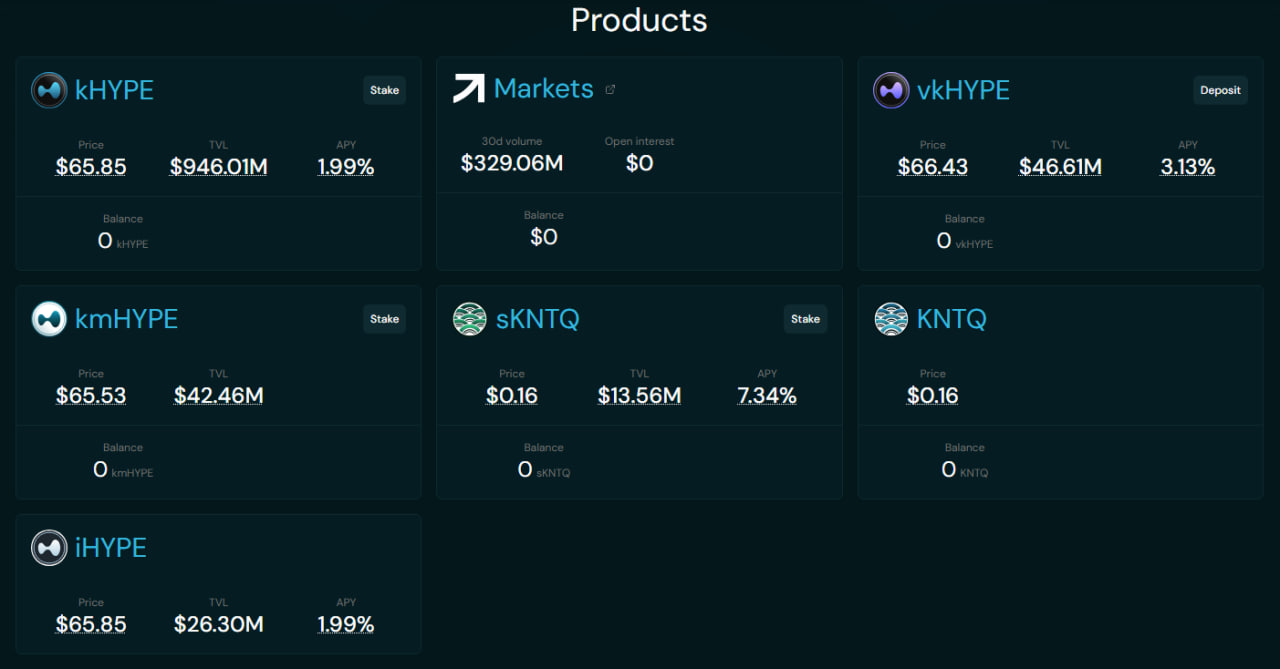
kHYPE is the flagship liquid staking token. Users stake HYPE and receive kHYPE, which can be used across supported HyperEVM DeFi applications. The official kHYPE token address shown in Kinetiq’s contracts page is 0xfD739d4e423301CE9385c1fb8850539D657C296D. Always verify token addresses from the official docs before importing or transacting.
Markets by Kinetiq and kmHYPE
Markets by Kinetiq is a trading product for perpetual futures. The Kinetiq homepage describes it as offering perpetual futures on equities, indices, currencies, and commodities, powered by Hyperliquid. Kinetiq docs also describe kmHYPE as a reward-accruing liquid staking token that represents HYPE staked to support Markets through Hyperliquid’s HIP-3 builder-deployed perpetuals.
Kinetiq Earn
Kinetiq Earn is described in official docs as a kHYPE DeFi strategy vault powered by Veda. Users can deposit kHYPE or HYPE, receive a vault receipt token called vkHYPE, and gain automated exposure to selected DeFi strategies. Automated vaults can reduce operational complexity, but they also add vault, curator, integration, liquidity, and underlying protocol risks.
Launch by Kinetiq
Launch is Kinetiq’s Exchange-as-a-Service product for Hyperliquid HIP-3. Official docs say it helps teams deploy and operate perpetual futures exchanges without independently meeting the full capital barrier for a HIP-3 deployer. Launch uses isolated staking pools and exchange-specific LSTs, meaning risk and returns are intended to be tied to the specific exchange deployment a user backs.
Institutional staking
Kinetiq documentation describes iHYPE as an institution-only liquid staking pool for HYPE, built for KYB/KYC-compliant entities with additional controls, privacy, and infrastructure. This product appears targeted to regulated or enterprise users rather than general retail use.
Kinetiq Token, Utility, and Incentives
Kinetiq does have an officially confirmed token. The official documentation identifies KNTQ as the governance token of the Kinetiq protocol and says it is the main instrument through which Kinetiq’s value accrues. The KNTQ docs also state that the token has a maximum supply of 1,000,000,000 KNTQ and that the KNTQ genesis event took place on on Hyperliquid.
Kinetiq also describes sKNTQ, a staked version of KNTQ. Based on the official token documentation and KNTQ app page, staking KNTQ for sKNTQ can connect to protocol rewards, referral shares, Markets fee discounts, and kmHYPE minting rights. These incentives depend on protocol rules and may change, so readers should review the official KNTQ docs before taking any action.
| Token or asset | Role | Important notes |
|---|---|---|
| HYPE | Native asset staked through Kinetiq | Users stake HYPE to mint liquid staking representations. |
| kHYPE | Kinetiq Staked HYPE | Designed to accrue staking rewards through exchange-rate appreciation. |
| KNTQ | Kinetiq governance token | Official docs state a 1 billion maximum supply. |
| sKNTQ | Staked KNTQ | Connected to protocol incentives such as fee discounts, referrals, and value accrual mechanisms. |
| kmHYPE | Markets-related LST | Represents HYPE staked to support Markets by Kinetiq. |
| vkHYPE | Earn vault receipt token | Represents a user’s share of the Kinetiq Earn vault. |
This page does not include price predictions, target valuations, or guaranteed yield claims. Token utility can be meaningful, but token price depends on market demand, supply, liquidity, emissions, governance decisions, protocol revenue, and broader crypto conditions.
Supported Chains, Integrations, and Partners
Kinetiq is primarily a Hyperliquid and HyperEVM project. The kHYPE docs also describe cross-chain swap functionality from Ethereum or Base into kHYPE on HyperEVM, powered by Enso. This does not mean every chain or bridge route is risk-free; cross-chain flows add bridge, routing, token approval, and execution risks.
The official homepage displays kHYPE integrations across the Hyperliquid ecosystem, including names such as Veda, Pendle, Felix, Hyperlend, PRJX, Native Markets, HypurrFi, Rysk, Treehouse, and Liminal. These are best described as displayed ecosystem integrations unless the relevant partner also confirms deeper partnership details.
For external technical context, Hyperliquid’s HIP-3 documentation explains builder-deployed perpetuals, including a 500,000 HYPE staking requirement for mainnet deployers, independent margining and order books, and slashing rules for malicious or dangerous market operation. Kinetiq Launch is built around making that HIP-3 deployment model more accessible through pooled and isolated staking infrastructure.
Kinetiq by the Numbers
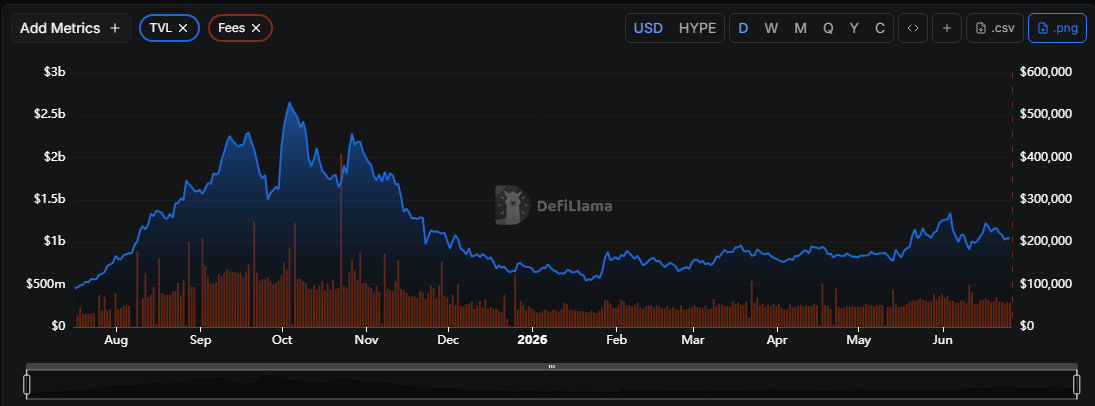
The following metrics are from public trackers and official documentation checked on . DeFi metrics move constantly, so readers should verify live data before relying on any number.
| Metric | Reported figure | Source context |
|---|---|---|
| kHYPE TVL | About $1.02 billion | DeFiLlama Kinetiq kHYPE page |
| Kinetiq Earn TVL | About $45.63 million | DeFiLlama Kinetiq Earn page |
| Kinetiq Markets 30-day perp volume | About $418.87 million | DeFiLlama Kinetiq Markets page |
| Kinetiq Markets cumulative perp volume | About $4.011 billion | DeFiLlama Kinetiq Markets page |
| Public audit reports listed | Eight Kinetiq protocol audit reports listed in docs | Kinetiq contracts and audits page |
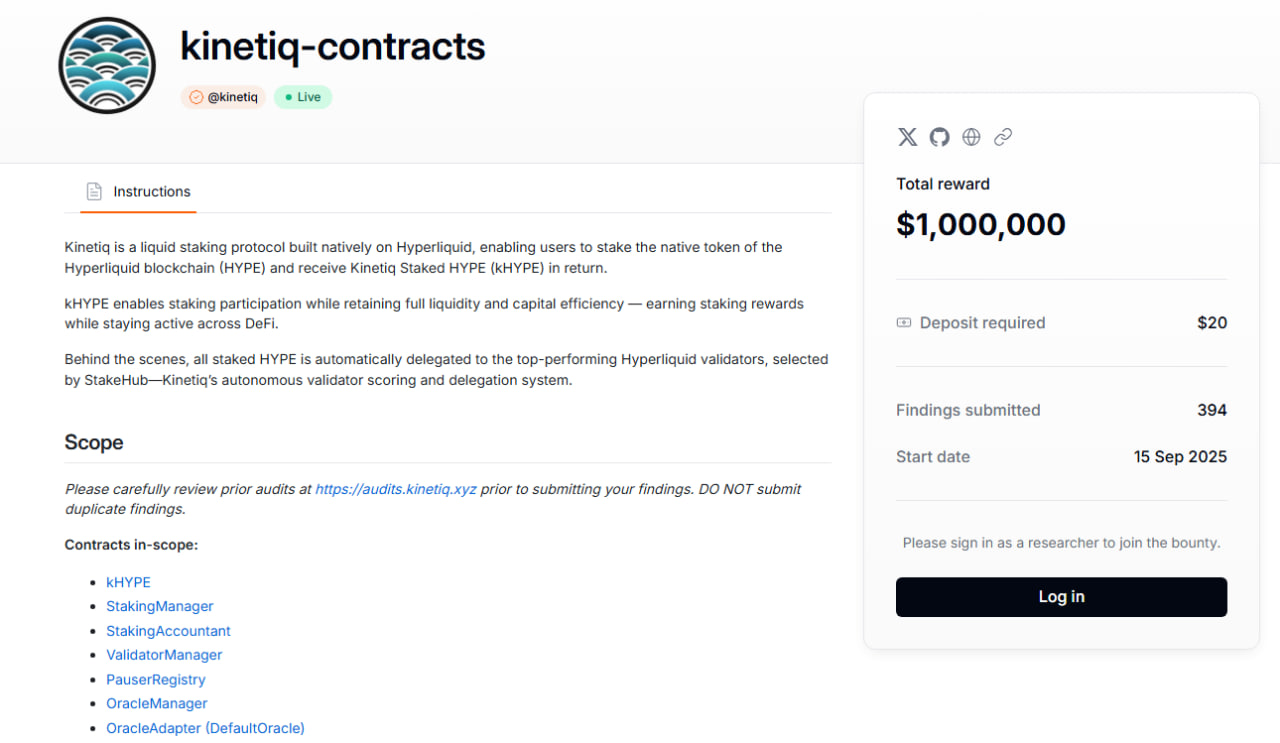
| Bug bounty | Cantina page lists a $1,000,000 total reward program | Cantina Kinetiq bounty page |
| Funding | Third-party tracker DeFiLlama lists a $1.75 million seed round | Not shown as official on Kinetiq docs; verify before publication-sensitive use |
Security, Audits, and Risk Management
Kinetiq publishes contract and audit information in its official docs. The contracts page lists mainnet deployments for kHYPE, kmHYPE, and several institutional deployments. It also links to audit reports from Spearbit, Zenith, Pashov Audit Group, and Code4rena, with report dates ranging from March 2025 through January 2026. The Launch documentation separately lists audits by Cantina and Zero Cool for the Launch product.
Kinetiq also links to a Cantina bug bounty. The Cantina page describes the kinetiq-contracts program as live and shows a total reward pool of $1,000,000. Bug bounties are useful because they incentivize responsible disclosure, but they do not prove that a protocol is safe.
Audits, verified contracts, monitoring, access controls, and emergency systems can reduce risk, but they cannot remove smart contract risk. Liquid staking protocols also depend on validator performance, oracle assumptions, withdrawal queues, liquidity venues, governance decisions, and the security of connected protocols.
How to Use Kinetiq: Step-by-Step
The exact interface may change, but the high-level process for kHYPE staking is documented by Kinetiq:
- Open the official Kinetiq website.
- Choose the Stake HYPE product and connect a compatible wallet.
- Confirm that your HYPE is available on the correct Hyperliquid or HyperEVM side required by the interface.
- Enter the amount of HYPE to stake and review the transaction details.
- Confirm the transaction in your wallet and wait for completion.
- After staking, verify that kHYPE appears in your wallet. Use the official token address if manual import is needed.
- To exit through the protocol, queue an unstake request and wait through the stated withdrawal delay. To exit faster through a market, understand slippage and liquidity risk first.
Users exploring Kinetiq Earn, Markets, or Launch should read each product’s docs separately. These products can introduce additional strategy, market, leverage, slashing, vault, operator, and liquidity risks beyond basic kHYPE staking.
Kinetiq Compared With Similar Crypto Projects
Kinetiq belongs to the broader liquid staking category, but it is highly specific to Hyperliquid. Compared with general liquid staking protocols on other networks, its differentiation comes from Hyperliquid-native validator delegation, kHYPE composability, Markets by Kinetiq, HIP-3 Launch infrastructure, and KNTQ/sKNTQ value-accrual mechanics.
| Category | Kinetiq | Typical alternative |
|---|---|---|
| Core chain focus | Hyperliquid and HyperEVM | Ethereum, Solana, Cosmos, or other ecosystems |
| Main product | HYPE liquid staking through kHYPE | Native staking, LSTs, or restaking derivatives |
| Validator selection | Automated validator scoring and delegation via StakeHub | Manual validator choice or protocol-managed delegation |
| DeFi composability | Designed for HyperEVM integrations and vault strategies | Depends on each chain’s DeFi depth |
| Exchange infrastructure | Markets and Launch connect to Hyperliquid HIP-3 | Usually separate from liquid staking products |
| Main risks | Smart contracts, validator performance, withdrawal queues, HIP-3 slashing, liquidity | Similar staking and smart contract risks, with chain-specific differences |
Risks and Important Considerations
Kinetiq is a real and documented project, but using it still involves crypto risk. Readers should consider the following issues before interacting with Kinetiq or any related token:
- Smart contract risk: Bugs, upgrade issues, or integration failures can affect funds even after audits.
- Validator risk: Liquid staking depends on validator performance, network rules, delegation logic, and possible slashing conditions.
- Liquidity risk: kHYPE, kmHYPE, KNTQ, or sKNTQ liquidity can vary across venues. Fast exits may involve slippage.
- Withdrawal delay risk: Protocol unstaking is not immediate and may require waiting through queue or lockup periods.
- Oracle and market risk: Markets, Launch, and HIP-3 products rely on market operation, oracle design, and deployer behavior.
- Vault and strategy risk: Kinetiq Earn depends on vault contracts, curators, and underlying DeFi protocols.
- Governance and token risk: KNTQ utility, incentives, and value accrual depend on protocol rules, market demand, and future governance.
- Regulatory risk: Staking, derivatives, token rewards, and exchange infrastructure may be treated differently across jurisdictions.
Kinetiq’s public docs are detailed, but users should verify official URLs, token addresses, contract addresses, audits, app permissions, and current terms before connecting a wallet.
FAQ About Kinetiq
What is Kinetiq crypto?
Kinetiq is a Hyperliquid-native liquid staking and DeFi infrastructure project. Its main product lets users stake HYPE and receive kHYPE, a liquid staking token designed for DeFi use.
What is kHYPE?
kHYPE is Kinetiq Staked HYPE. It represents HYPE staked through Kinetiq and is designed to accrue rewards through exchange-rate appreciation instead of manual reward claiming.
Does Kinetiq have a token?
Yes. Kinetiq’s official documentation identifies KNTQ as the governance token of the protocol. The docs state that KNTQ has a maximum supply of 1,000,000,000.
Is Kinetiq an airdrop project?
Kinetiq previously operated kPoints and has an officially launched KNTQ token, but this article does not claim any active or future airdrop. Only rely on official Kinetiq announcements for airdrop or rewards information.
Which chain does Kinetiq support?
Kinetiq is built for Hyperliquid and HyperEVM. Its docs also describe Enso-powered swap functionality from Ethereum or Base into kHYPE on HyperEVM.
Is Kinetiq audited?
Kinetiq publishes audit links in its official docs, including reports from Spearbit, Zenith, Pashov Audit Group, and Code4rena. Launch docs also list Cantina and Zero Cool audits. Audits do not guarantee safety.
Can I instantly unstake kHYPE?
Standard unstaking involves a delay period. Users may be able to trade kHYPE on supported venues for faster liquidity, but that can involve slippage and market risk.
Is Kinetiq safe to use?
No DeFi protocol can be called risk-free. Kinetiq has public docs, audits, contracts, and a bug bounty, but users still face smart contract, validator, liquidity, oracle, governance, market, and regulatory risks.
Conclusion
Kinetiq is one of the more developed DeFi projects in the Hyperliquid ecosystem. Its core product, kHYPE, gives HYPE holders a liquid staking route, while StakeHub handles validator scoring and delegation. Around that base, Kinetiq has added Earn, Markets, Launch, institutional staking, and KNTQ-related incentives.
For users researching the Kinetiq project, the most important takeaway is that Kinetiq is not only a staking app. It is a broader Hyperliquid-native infrastructure stack that connects liquid staking, DeFi composability, HIP-3 markets, and token-governed incentives. That expanded scope also means expanded risk. Read the official documentation, verify every contract address, and understand the mechanics before using any product.
Responsible crypto disclaimer
This article is for educational purposes only. It is not financial, investment, legal, or tax advice. Crypto products involve smart contract, liquidity, market, bridge, oracle, governance, validator, slashing, and regulatory risks. Readers should do their own research and consult qualified professionals where appropriate.